How to Escape Maya: The Real Path of Naam Jap
How to escape maya through naam jap — Premanand Maharaj on recognizing maya, prarabdha vs sanchita karma, and surrendering to the divine name.
Some days the mind just gives up. One question rises through the noise: how to escape maya? It feels like we're surrounded — and every day, maya wears a new face.
How to Escape Maya: First, Recognize What Maya Really Is
In the Bhajan Marg tradition of Shri Premanand Ji Maharaj — the revered saint of Vrindavan, the sacred land of Radha and Krishna — this question surfaces again and again. And Maharaj ji's answer never changes: first, learn to recognize maya.
We assume money is maya. The house is maya. Relationships are maya. But Maharaj ji says no — an object or a circumstance is not maya by itself.
"वह वस्तु, वह व्यक्ति, वह स्थान, वह घटना, भक्ति जो भगवान की स्मृति करा दे। और जो भगवान की विस्मृति करा दे, वो वस्तु, वो व्यक्ति, वो घटना, वो परिस्थिति, वो माया।"
"That object, that person, that place, that event which makes you remember God — that is bhakti. And whatever makes you forget God — that object, that person, that event, that circumstance — that is maya."
15:21
The yardstick is simple. If God comes to mind, it's bhakti. If God slips away, it's maya. The same circumstance can be devotion for one person and bondage for another. The difference lives inside, never outside.
(And this took me a long time to understand.) Maya is incredibly subtle. Some action, some event, and suddenly the thought of God is gone. Worldly thinking has crept in. That fast. Maya has caught you.
This is where the seeker's journey actually begins. Recognition is half the battle won.
Then a deeper question rises: does prarabdha — the karma destined for this lifetime — force us into maya? And can naam jap, the chanting of the divine name, change anything?

Can Prarabdha Be Changed? What Naam Jap Actually Does
Suraj Singh ji from Sitapur asked this exact question: "What effect does naam jap have on what is already written in destiny?"
Maharaj ji explained the difference between sanchita and prarabdha. What has come to be experienced in this birth is prarabdha — it is amogha, unfailing, it will not pass without being lived through. "Mogh means going to waste, amogh means not going to waste."
Recall the story of Vashishtha ji. Through his disciple's connection, the prarabdha of nose-cutting fell on him. The disciple was completely innocent, yet had to bear it. This is the certainty of prarabdha. Even innocence does not grant exemption.
But there is also hope here. The sanchita karmas — the seeds of the future that have not yet ripened into prarabdha — these can be destroyed by naam jap.
"जो प्रारब्ध नहीं, जो संचित जमा है, वह नष्ट हो जाएगा।"
"What is not prarabdha — what is stored as sanchita — that will be destroyed."
7:13
This, I believe, is the greatest assurance Maharaj ji gives to seekers. And practice itself should be done as God's grace:
"भगवान की कृपा है तो नाम जप हो रहा है। भगवान की कृपा है तो साधना हो रही है।"
"It is God's grace that naam jap is happening. It is God's grace that sadhana is happening."
14:43
When this feeling settles in, ego dissolves. When ego dissolves, sanchita karma weakens, slowly. The intellect can accept this logic. But God's lila is not understood through intellect. Only through the devotee's lived experience.
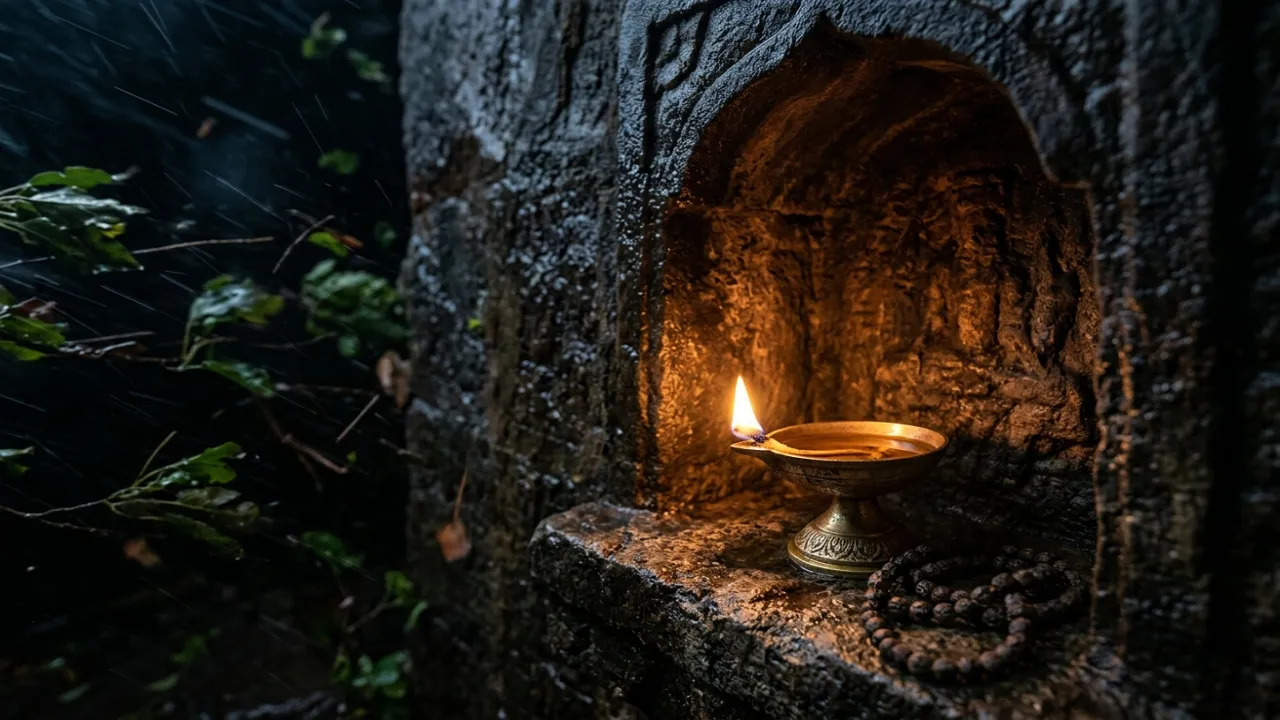
God's Lila Beyond Reason: The Stories of Namdev and Madhavdas
When the glory of Sant Namdev ji reached the king, the ruler sent a jewel-studded bed as an offering. Namdev ji threw it into the river. The king flew into rage, demanding, "Bring the bed back!" Out came a hundred beds. The king fell at his feet and begged forgiveness.
And the same Namdev ji, when going for darshan of Lord Vitthal, worried his shoes might be stolen. So he tied them in a cloth and bound it to his waist. Lost in bhajan, the knot loosened, the shoes fell. The temple attendants beat him soundly.
Now you tell me. Someone who can throw a jewel-studded bed into a river — would he fear the theft of a pair of shoes? Reason cannot answer this. Maharaj ji says:
"उनको पिटवाना है तो ऐसा करवा दिया, पुजवाना है तो ऐसा कर दिया।"
"When He wants them beaten, He arranges it so. When He wants them worshipped, He arranges that too."
9:20
Madhavdas Baba was absorbed in bhajan at Jagannath Puri. He had not eaten for several days. Lord Jagannath himself came carrying a plate of bhog, fed the baba, and disappeared. The baba washed the plate in the sea and placed it outside his hut. The temple attendants arrived. "You stole the plate?" Sticks rained down. God feeds, and gets His own servant beaten.
Then once Lord Jagannath said to the baba, "The jackfruit pulp from the king's garden is wonderful — shall we go?" He had the baba climb the tree and stood below himself. The baba plucked the pulp, exclaimed "Wah wah!" God said, "Don't speak so loudly," and then Himself loudly cried "Wah wah!" The royal guards came running. God vanished. The baba was caught.
When presented before the king the next morning, the king prostrated himself and signed over the entire garden in the name of Jagannath ji. "He ate the pulp Himself, got the garden registered in His own name, and got the baba beaten with sticks."
This is God's lila. Neither understandable, nor explainable. Yet a deep purpose hides beneath it:
"भगवान अपने भक्तों को बुलेट प्रूफ बना देते हैं कि उसके ऊपर संसार का कोई प्रभाव ना पड़े, मान, सम्मान, इसका किसी भी तरह ना पड़े।"
"God makes His devotees bulletproof, so that the world has no effect on them — neither honour nor insult can pierce them in any way."
11:16
Just as glass is repeatedly thrust into hot and cold to make it bulletproof, so does God forge His devotee. And there is only one tool for this forging: ceaseless naam jap.
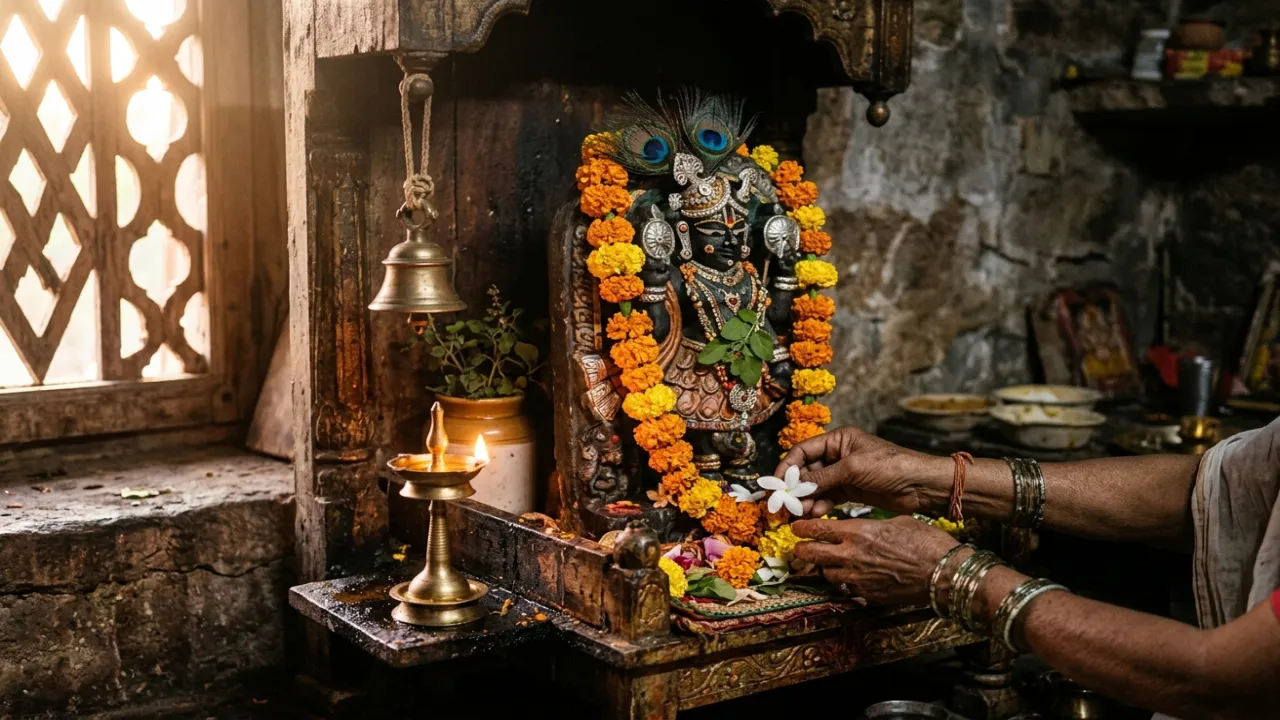
Naam Jap Is the Only Way: Refuge in Madhav, Protection from Maya
Payal Sharma ji from Jammu asks: "My mind wanders into maya, hurts Shri ji through wrong actions. What should I do?"
Maharaj ji has only one answer. Again and again. Without tiring.
"जिसमें बस एक ही उपाय राधा राधा जपो। तुम प्रसन्न रहो। तुम स्वस्थ रहो। यही हम देख रहे हैं। यही हमें सुख है।"
"There is only one remedy in this — chant Radha Radha. Stay joyful. Stay well. This is what we wish to see. This alone gives us happiness."
3:07
Do sadhana. Naam jap or lila-shravan, the listening of divine pastimes. But do it as God's grace. "Ya gun sadhan te nahi hoi, tumhri kripa pav koi" — none can attain it through their own effort, only through Your grace. When we treat sadhana as our achievement, ego gets fed somewhere. And where ego stands, divine virtues cannot enter.
When the feeling of grace arrives, ego dissolves. Divine virtues come. Maya slowly loosens its grip. For one who has taken refuge in God, even when the body must endure prarabdha, the mind can stay joyful. Maya cannot enter within.
But the subtlety of maya does not stop here. It catches us by getting a "yes" from inside.
Maya's Subtle Grip: Escaping the Inner "Yes"
This is the trickiest thing. (I too once thought maya was something external that catches us.) But what Maharaj ji said sank straight into the heart:
"माया बाहर से फंसा ले तो बात है, हम अंदर से राजी हो जाते हैं। यार, चलो, ठीक है।"
"It would be one thing if maya trapped us from outside. The truth is, we agree from inside. 'Okay, fine, let it be.'"
16:44
This is the real danger. Maya comes from outside: some situation, some remark. But we say from within, "okay, it's fine, it works," and accept it. Right there, the slipping starts. Slipping and slipping, we reach a place where calamity finds us.
The escape route? Only one. The moment the inner "okay" rises, immediately, "Radha Radha." Treating sadhana as grace blocks ego from forming, and the inner "yes" gets no chance.
Maya is powerful. She has many arrows. If one task fails, then another. If the second fails, the third. She insists on bringing you down. This is why there is no path other than refuge in God. "Whoever has come to My shelter — they alone have crossed maya."
How to Escape Maya: The Essence and Seekers' Questions
After hearing all this, four things to remember:
- Maya is whatever makes you forget God. The yardstick is one, no other.
- Prarabdha must be lived through, but sanchita karma is destroyed by naam jap. This is the assurance.
- Do not try to understand God's lila. It is known only through the devotee's experience.
- Continuous absorption in God is freedom from maya. Stop the inner "yes," chant the name.
"जब निरंतर भगवदाकार वृत्ति है, तो माया मुक्त पुरुष है। न सोचति, ना कांक्षति, ना कोई सोच है, ना कोई चाह है, तो भगवान में निरंतर रमण कर रहा है।"
"When there is continuous absorption in the form of God, the person is free from maya. Neither worrying, nor desiring — no thought, no craving — they are continuously immersed in God."
18:04
The word "continuous" is hard. Maharaj ji himself admitted this. But the journey begins with one "Radha Radha." Today. Right now.
Frequently Asked Questions

Independent writer, jaapak.com
I built the Jaapak app. I write in simple Hindi on the Bhagavad Gita and the satsang tradition — so seekers don't struggle with the scripture.
Read all articlesAbout this article
The commentary is based on the general understanding of the Sanatan tradition and written in accessible language. No verbatim quotation of any modern commentator is used.