How to Chant Radha's Name: The Simplest Path to Overcoming Maya
Premanand Maharaj on chanting Radha's name in the present — dissolving ego, conquering Maya, the simple path to inner peace.
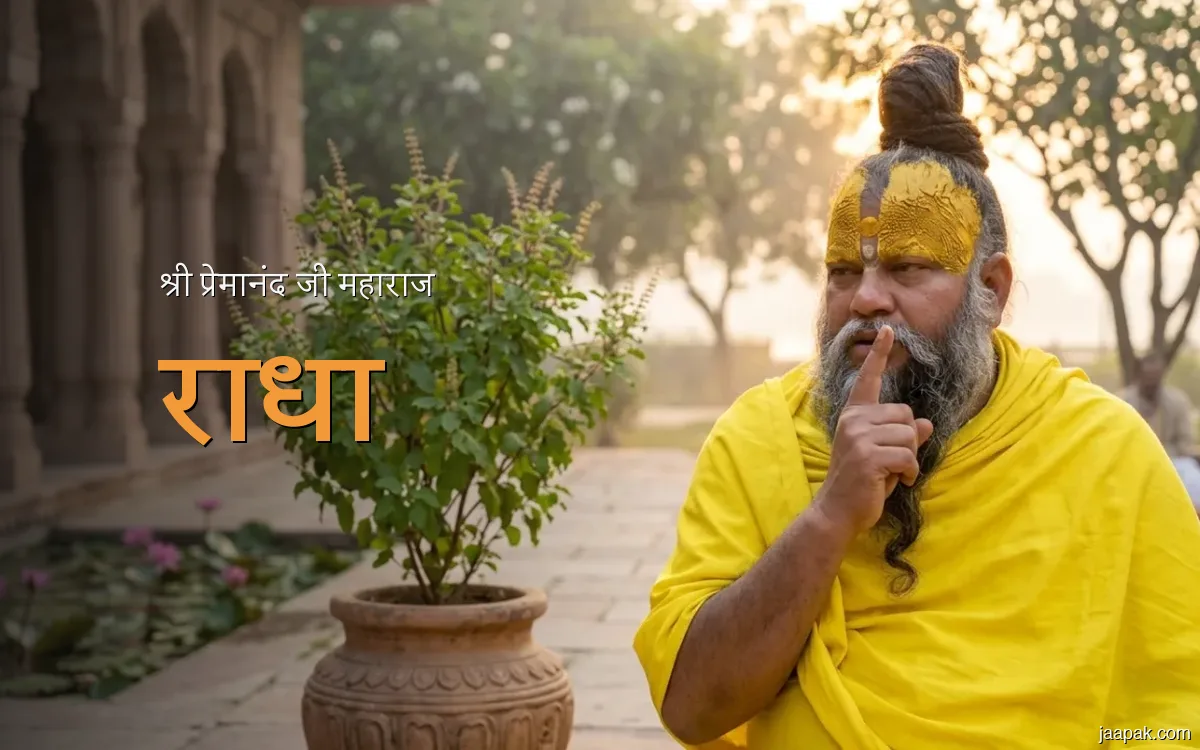
Your mind wanders the moment you sit down to pray. The prayer beads move through your fingers, but your thoughts have drifted to an old regret, a half-healed wound, or tomorrow's to-do list. Sound familiar?
Most of us approach spiritual practice as if there's a complicated technique we haven't learned yet: the right mantra, the right posture, the right time. But Shri Premanand Ji Maharaj, a revered saint in the Braj-Vrindavan devotional tradition centered on the divine love of Radha and Krishna, offers something disarmingly simple: the problem is not your technique. It's that you're not here, right now.
His teaching on chanting the divine name (naam jap) isn't a ritual prescription. It's a radical reorientation toward the present moment, and it cuts through anxiety, ego, and maya (the illusion of separation from the Divine) in ways that no amount of reading or rule-following can.
What Is the Right Way to Chant Radha's Name?, Maharaj Ji's Answer
Naam jap (the repetitive chanting or remembrance of a divine name) is one of the oldest and most universal spiritual practices in the Hindu tradition. But Shri Premanand Ji Maharaj strips it down to its bare essential.
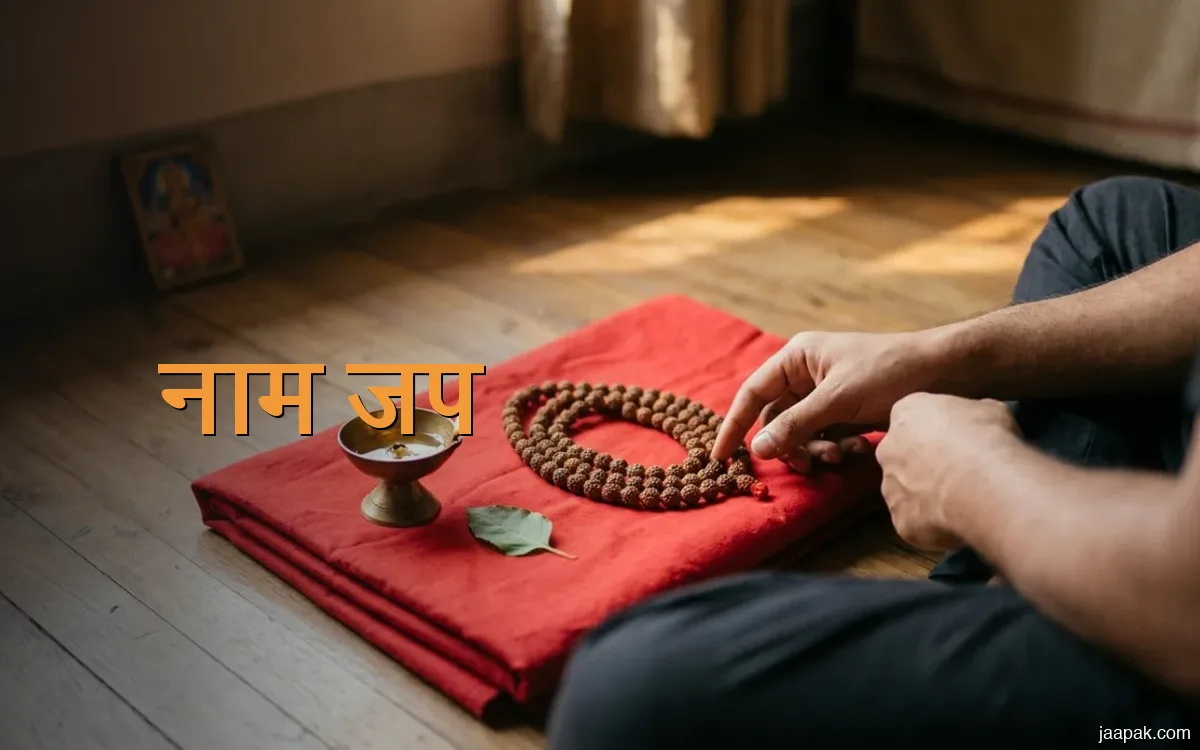
He says: chanting is not about moving a mala (prayer beads) through your hands. If the beads rotate but your mind is elsewhere, what have you actually done?
The real practice is simple: bring your attention to Radha's name in this moment. Breathe in, Radha. Breathe out, Radha. That's it. No special location required, no sacred hour, no prerequisite ritual. In the kitchen, on the commute, in a meeting. Wherever you are, however you are, you can chant.
Every moment can be made sacred through the divine name.
And then Maharaj Ji says something that stops you in your tracks: technique is smaller than feeling, and feeling is smaller than love. Ritual has its place, but God is hungry for love, not for rule-following.
"जान ले सो जानन हारा, राम केवल प्रेम प्यारा।"
"Whoever truly knows, knows this — the Divine loves only love."
5:19
We tie ourselves in knots about having the right mala, the right mantra, the right time slot. And here is a saint telling us plainly: Radha wants your love. Just that. The mind resists such simplicity. Surely it can't be this easy? But Maharaj Ji insists: it is exactly this easy.
How to Stop the Past From Hijacking Your Spiritual Practice
In one satsang, a young woman told Maharaj Ji she'd been through difficult experiences in childhood. Her mind wouldn't settle. She couldn't focus on her studies or her practice.
Maharaj Ji's response was breathtaking in its directness.
"तुम्हारे साथ जो गलत हुआ, वह तो हुआ ही। आप अब अपने साथ गलत कर रहे। अब अपने साथ गलत मत कीजिए।"
"What happened to you — that happened. But now you are doing the wrong to yourself. Stop doing wrong to yourself now."
2:45
This lands hard. Past pain takes from us twice: once when it happens, and again every time we replay it. The past cannot be changed. But this present moment, each one of them, belongs entirely to us.
Why, Maharaj Ji asks, would you destroy a fresh, new moment by filling it with old grief? What has already happened should be treated like a bad dream, acknowledged and released. And when the mind drifts back? Cut it off with the name: Radha, Radha, Radha. Don't engage with it, don't argue with it, just return to the name.
(I used to believe you had to resolve the past before you could move forward. Maharaj Ji's teaching shifted something: the past isn't meant to be resolved. It's meant to be released.)
He uses the image of a wrestler to explain perseverance. A champion isn't forged in a single bout. He gets pinned ten times before he masters the craft. Falling in spiritual practice is part of the practice. When you slip, don't spiral into despair. Get up, and start again. The stumbling is not failure. It's training.
Can Chanting in the Present Moment Actually Cut Through Maya?
Maya is one of those Sanskrit concepts that sounds abstract until someone explains it well. Maharaj Ji does it with a mirror.
Imagine a mirror placed between you and a single object. Suddenly you see two. Remove the mirror, and there is only one. That is the relationship between the individual soul (jiva) and God (Ishwar).
"माया के कारण एक माया लिप्त दर्शन है जीव और एक माया निर्लिप्त दर्शन है ईश्वर। माया हटाओ, तो ईश्वर ही ईश्वर है। जीव नाम की कोई वस्तु नहीं है।"
"Because of maya, there is one view veiled by maya — that is the jiva (individual soul) — and one view free of maya — that is God. Remove maya, and there is only God. There is no separate thing called 'jiva'."
7:36
Pause on that. The "I" we experience as a fixed, separate self is a trick of the mirror. The Divine is already everywhere, and maya is simply the layer obscuring that truth. This is not poetry. Maharaj Ji presents it as a lived, practical experience available through sustained practice.
Present-moment naam jap gradually thins that layer. Each "Radha" is a hairline crack in the mirror. When the burden of "I" feels lighter, when the constant inner commentary quiets even slightly, that is the name working.
The direct experience of God (bhagwat sakshatkaar) emerges through love, and naam jap is the daily exercise of that love. Not in the beads. In the feeling.
Ego and Chanting: The Mahout and the Elephant
A sincere practitioner once told Maharaj Ji: two years ago, I had a beautiful inner experience. Now it's completely gone. My ego has grown and my devotional feeling has dropped.
Maharaj Ji's response names the mechanism precisely.
"यह जो अहम है ना, ये भगवत अनुभूति नहीं होने देता। तो गुरु कृपा से जब यह हम नष्ट हो जाता है, तो अनुभूति स्थाई होती चली जाती है।"
"This ego — it prevents the divine experience from taking hold. When the ego is dissolved through the Guru's grace, the experience becomes permanent."
10:58
Ego, he says, is an elephant without a mahout (keeper). An elephant is enormously powerful, but without its handler, it tramples everything in its path. The Guru's grace is the mahout that brings it under control.
The practitioner's problem was this: the experience came, but the ego claimed it. "I had an experience", and that very "I" is what prevents the experience from becoming permanent. The subtlest and most dangerous trap in spiritual life: the ego that appropriates your own awakening.
This is the insight no one tells you: you can fall after the experience. Often because of it.
Naam jap is the practice of drowning that "I." When you genuinely chant "Radha," there is no room for "me." The name and the namer cannot coexist.
Look at the practitioners around Maharaj Ji: graduates, officers, people with impressive credentials. They've set all of it aside to surrender at the Guru's feet, and their minds are undisturbed. Because the mahout is present. Even Hanuman Ji, the embodiment of wisdom, said: "There is no knowledge in us." That humility is the shield against ego, and ego is the only thing between you and a permanent experience of the Divine.
Why Spiritual Experience Doesn't Last Without a Guru
Devotion cannot be downloaded from a book.
Maharaj Ji is unambiguous: read every scripture you can find, attend a hundred discourses, and without surrender to a Guru, the experience doesn't hold. Maya comes back.
"जो वर्तमान को संभालता है, उसका भविष्य उज्जवल होता है।"
"Whoever takes care of the present moment — their future is luminous."
0:47
And the greatest support for taking care of the present moment is the Guru's refuge and naam jap together.
He teaches something counterintuitive about praise and criticism: treat honor as poison and insult as nectar. When someone compliments you, immediately redirect it: "Whatever I have is by Shri Ji's grace — this pranam belongs to the Guru." The stories of Vibhishana and Hanuman Ji carry this lesson: humility and loyalty to the Guru are what make inner experience stable.
And what does "taking refuge in the Guru" actually mean? It doesn't mean sitting physically near him. It means living by his words. A disciple a thousand miles away who follows the Guru's guidance is closer than someone sitting at his feet who ignores it.
Guru's grace and naam jap together accomplish what neither can do alone.
The Right Mala, Mantra, and Place, A Practical Guide to Daily Chanting
Every beginner asks the same practical questions. Which mala? How many beads? Which corner of the house? And which mantra: just "Radha," or the full Hare Krishna mahamantra?
Maharaj Ji's answer always returns to simplicity.
Mala (prayer beads): Tradition recommends a 108-bead tulsi mala. Tulsi is dear to Radha Rani, so the impressions of japa ripen faster on it. If tulsi is unavailable, rudraksha or shankha (conch) beads work. If even those are out of reach, count on your fingers. The mala exists for the name; the name does not exist for the mala.
Mantra: The single word "Radha" is the simplest mantra of all. Initiated practitioners may chant the Hare Krishna mahamantra; those without diksha (formal initiation) can begin with "Radha Radha" alone. The name of Radha quietly contains both Krishna and Radha herself.
Place: Pick one corner of the home where you can sit every day, but do not let the corner become a cage. The divine name sanctifies wherever it is uttered. On a train, in a cubicle, on a hospital bed: say Radha. The name does not wait for the right place; it changes the place.
Facing east or north follows tradition, not a binding rule. Cleanliness of the mind matters more than cleanliness of the seat.
(I made this mistake for months, wanting every detail to be "right": the right hour, the right mala, the right direction. The chanting never started. The first time I said "Radha Radha" on a city bus, the lesson landed: the biggest obstacle to a practice is waiting for the perfect conditions to begin one.)
When and How Much to Chant, From One Mala to Sixteen, the Progressive Path
Brahma muhurta (the ninety-minute window before sunrise) is the traditional ideal: the mind is quiet, the world is asleep, and sadhana flows easily.
But brahma muhurta is not realistic for every seeker. Shift work, a newborn, illness, a long commute: the reasons are many. Maharaj Ji refuses to let this become an excuse. If the dawn hour is not available, chant in the middle of your day. Radha while washing dishes, while putting a child to sleep, during the office lunch break. (Detail: The Spiritual Merit of 24-Hour Chanting in Kali Yuga.)
A workable progression looks like this:
- Month one: One mala (108 names) every day, no missed days. If a day slips, make it up the next day with two malas.
- Months two and three: Four malas, two morning and two evening. The mind starts to accept discipline.
- From month four: Eight malas, about an hour of practice. The habit is solid.
- When the mind is ready: Sixteen malas, the Gaudiya standard.
This is not a race. Consistency beats quantity. Sixteen malas one day followed by a week of nothing is worse than one mala every single day. The pot fills drop by drop.
When the chanting begins to flow without counting, that is the early stirring of ajapa-japa, the name running on its own with each breath. At that point, set the beads aside and simply listen.
(In the beginning, counting is necessary. Without it the mind cheats, claims "done," and slips away. After a certain stage, the mala falls away on its own, because the name itself has become the mala.)
5 Signs Your Naam Jap Is Bearing Fruit, How to Know You're Progressing
Many practitioners ask: "I'm chanting every day, but how do I know if anything is happening?" The wider Vaishnava tradition, and Maharaj Ji's discourses, point to five clear signs. Even one of them showing up is evidence that the practice is ripening.
- Small irritations stop biting. What used to flip into anger immediately now allows a pause. A small gap appears between trigger and reaction, and inside that gap, the impulse to say "Radha" can finally arise.
- Loneliness eases. In a crowd or by yourself, a quiet companionship stays with you. The weight of "I am alone" gradually lifts.
- Old memories sting less. Past wounds stop ambushing you the way they used to. They arrive, pass, and don't grip.
- The restless part of the mind grows still. A baseline anxiety that used to hum without reason gives way to steadiness. Sleep deepens. Dreams lighten.
- Worldly cravings lose their pull. The chase for new clothes, new gadgets, new flavors loses its old flavor. This is the seed of vairagya (non-attachment), not forced but natural.
These signs do not arrive on a schedule. One may show up in the first month, another after a year. Maharaj Ji's instruction: do not watch for the fruit, just keep watering. A gardener does not pull up the plant every day to inspect the roots. Naam jap is that quiet, daily water.
The Ten Nama Aparadhas, Offenses That Destroy the Fruits of Chanting
Radha's name is the supreme mantra, yet the Padma Purana warns that certain offenses can wipe out the fruits of japa. This is why Maharaj Ji's satsangs return so often to humility and to the company of saints. These two are the natural protection against the malefactor of progress (nama aparadha).
The ten principal nama aparadhas (per the Brahma Khanda of the Padma Purana):
- Sadhu ninda. Speaking against, or listening to slander of, any saint or sincere devotee.
- Treating devatas as opposed. Viewing Shiva, Vishnu, and others as rivals rather than as one Divine in different forms.
- Disregard for the Guru. Treating the Guru as an ordinary person and ignoring his words.
- Shastra ninda. Disparaging the Vedas, Puranas, Gita, or Bhagavatam.
- Reducing the name to "just a word". Interpreting the name as mere sound, stripping its inherent power.
- Sinning on the strength of the name. Deliberately doing wrong with the calculation, "I'll chant later, the sin will be cleared." This is the most dangerous of the ten. (Detail: Can Chanting Erase Sins and Karma?.)
- Equating the name with ordinary good deeds. Placing charity, yajna, and other auspicious acts on the same level as the name.
- Forcing the name on the unwilling. Preaching the name to someone who has no interest in hearing it.
- Disbelief in the name's glory. Hearing about the name's power and still doubting it.
- Carelessness in chanting. Mind wandering while the mala turns mechanically. This too counts as an offense.
These offenses damage the fruits of japa, but the answer is not to abandon the practice. Maharaj Ji's path is the opposite: if an offense slips out, atone for it with the same name. The name is itself the remover of offenses against the name. The deepest alertness is humility.
(Hanuman Ji once said, "There is no knowledge in any of us." That one sentence is a shield against both ego and nama aparadha.)
Related Teachings
- How to Start Naam Jap: 25 Questions Every Beginner Has
- Meera Bai's Lesson: Why the World Is Temporary | Naam Jap
- Premanand Maharaj Diksha: The Real Path to God-Vision
- How to use a japa mala the right way
Radha's Name, Right Now, This Moment
Let go of the past. Let go of worry about the future. Right now, in this breath, chant Radha's name.
Ego is cut through naam jap. Maya is cut through naam jap. And the Guru's refuge makes that cutting permanent. Lord Shiva's words say it all:
"तेही समाज गिरजा में रह अवसर पाए, वचन एक कह, हरि व्यापक सर्वत्र समाना, प्रेम ते प्रगट होए, मैं जाना।"
"In that assembly, Shiva found the moment and said one thing: Hari (God) pervades everywhere, equally — and through love, the Divine is revealed. This I know."
5:07
The Divine is already everywhere. Love is the key. And naam jap is the daily practice of that love.
The seeker has just one work: to fill each present moment with Radha's name.
Radhe-Radhe.
Source: #810 Ekantik Vartalaap & Darshan / 04-02-2025 / Shri Hit Premanand Govind Sharan Ji Maharaj
This article is compiled from the satsangs of Shri Premanand Ji Maharaj. The original video is available at the link above. All images in this article are digitally created.
Frequently Asked Questions

Independent writer, jaapak.com
I built the Jaapak app. I write in simple Hindi on the Bhagavad Gita and the satsang tradition, so seekers don't struggle with the scripture.
Read all articlesAbout this article
The commentary is based on the general understanding of the Sanatan tradition and written in accessible language. No verbatim quotation of any modern commentator is used.
Related Articles
How to Focus the Mind in Naam Jap: Premanand Maharaj
Apnapan: 5 Sutras to Make God Truly Yours | Premanand Maharaj
Why Divine Name Chanting Feels Empty: a Saint's Answer
The Power of Naam Jap: Beyond Ritual to True Sadhana
Premanand Maharaj Diksha: The Real Path to God-Vision
How to Start Naam Jap: 25 Questions Every Beginner Has